Performance and Responsibility in Cleaning
At Vileda Professional, we consider environmental and social responsibility alongside product performance, quality and customer requirements when developing our products and solutions.
As part of the Freudenberg Group, we aim to provide cleaning solutions that deliver effective and hygienic cleaning while supporting the responsible use of materials and resources throughout the product lifecycle.
Environmental and social responsibility are important principles within the Freudenberg Group. For many years, Freudenberg and Vileda Professional have invested in initiatives relating to the management of materials, waste, energy, emissions and water across their operations.
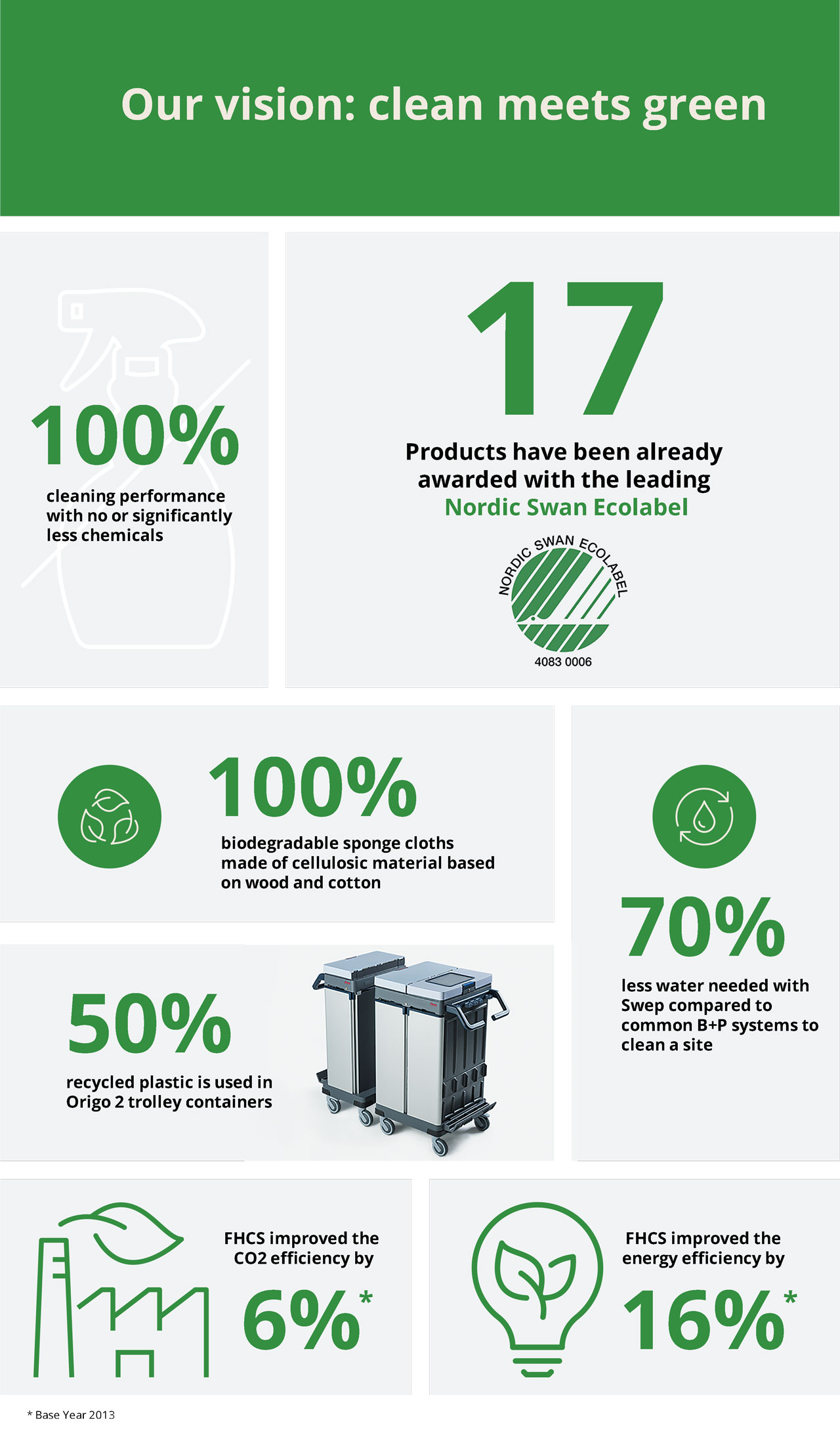
These efforts help inform the design and development of our products, including the use of recognised certifications, recycled materials in selected product ranges, and ongoing improvements to product durability, performance and resource efficiency.
Balancing Cleaning Performance and Resource Efficiency
Vileda Professional products are designed to deliver effective cleaning performance, support hygiene requirements and provide practical, ergonomic solutions for professional users.
Customers rely on our products for cleaning performance, ease of use and durability. Alongside these priorities, we consider factors such as material selection, product longevity, manufacturing processes and resource use throughout the product lifecycle.
Our approach is focused on maintaining high product standards while exploring opportunities to improve resource efficiency, increase the use of recycled materials in selected product ranges and support recognised third-party certification schemes where applicable.
We assess both the impacts associated with the production, use and end-of-life management of our products, as well as how product design can help customers use resources efficiently during cleaning operations.
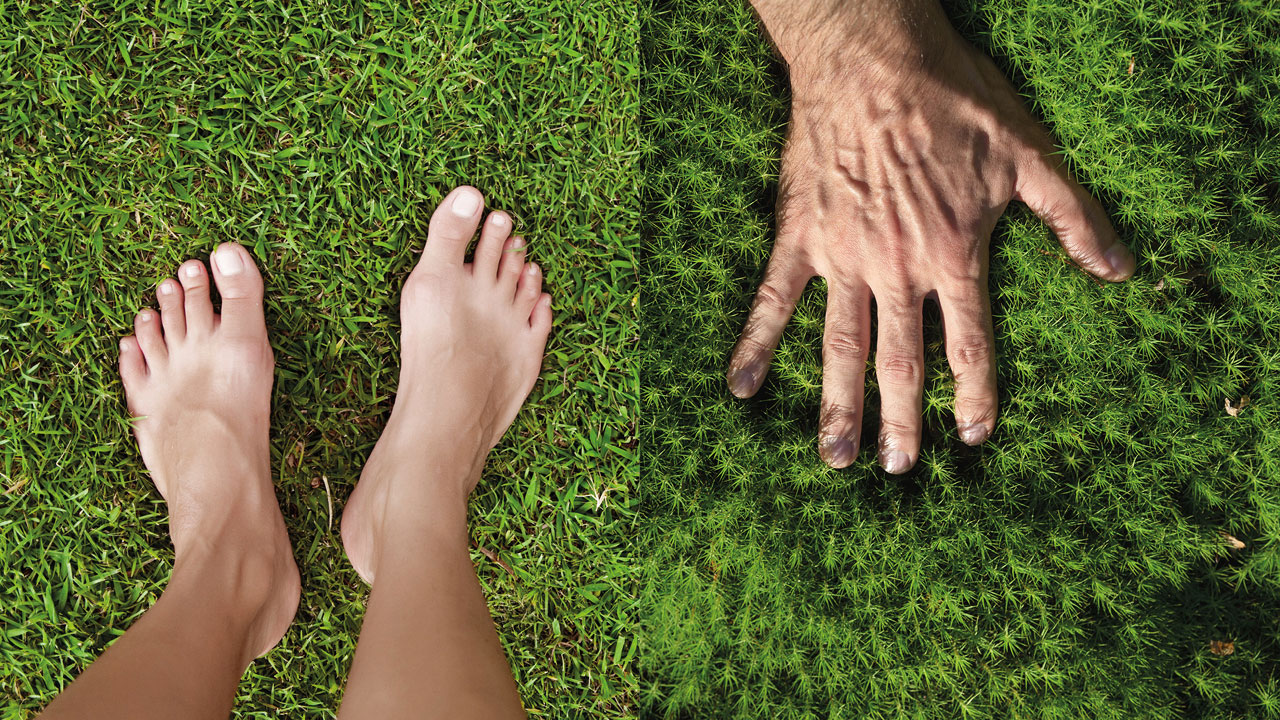
Footprint and Handprint: Our Assessment Framework
At Freudenberg, we use the terms "footprint" and "handprint" to assess different aspects of a product's lifecycle. Footprint refers to impacts associated with materials, manufacturing, transportation and end-of-life management. Handprint refers to factors such as product durability and resource use during operation. Together, these measures help inform our product development approach.

Our Ongoing Approach to Product Development and Resource Management

By considering these factors together, we aim to support informed product design decisions across areas such as material selection, manufacturing, transportation, product use, durability and end-of-life management.
We continually review opportunities to improve our products, packaging and internal processes. This includes projects focused on material efficiency, product durability, packaging optimisation and the increased use of recycled materials where appropriate.
We also work with external organisations, certification bodies and industry partners to support the development of products and processes that align with our business objectives and product lifecycle considerations.
As a part of our initiative, Freudenberg Home and Cleaning Solutions have committed to ambitious sustainability targets for 2025.
We are proud to announce that we are a signatory of the Ellen MacArthur Foundation’s New Plastics Economy Global Commitment. As such we
- commit to review 100% of all products globally and eliminate problematic or unnecessary packaging by 2025.
- strive to achieve 100 percent of all packaging to be recyclable, reusable or compostable by 2025.
- aim to achieve 50% recycled content across all packaging and 25% recycled content in plastic packaging in 2025
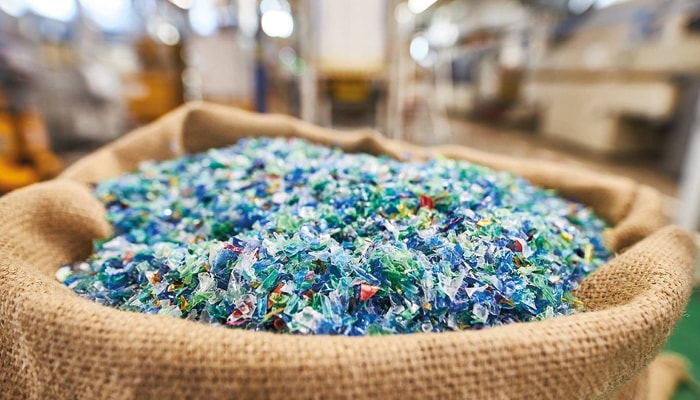
- will increase the amount of recycled material of our solid plastic products from currently 46 percent to 50 percent by 2025
- will explore options to further change from single to multi-use containers in warehouse/factory logistics and B2B transportation.
Product Lifecycle Considerations at a Glance
Customers around the world rely on Vileda Professional cleaning solutions for their performance, durability and ease of use.
When developing our products, we consider factors such as material selection, manufacturing, product use, durability and end-of-life management. Our product assessment framework includes both lifecycle impacts ("footprint") and operational resource use ("handprint"), helping to inform product development and continuous improvement initiatives across the range.